


Theoben Jerdan C. Orosa, J.D., MPP, LLM
New Era University
Research shows a strong likelihood that faculty members are tired, are overworked, and have no time to research and write (Salazar-Clemeña & Almonte-Acosta, 2007, p. 9). In a quantitative study by Safary Wa-Mbaleka, the lack of time to write had been linked to the lack of publications by some Philippine higher education institutions (Wa-Mbaleka, 2015, p. 130). A similar finding was reached with another observational study with faculty members citing heavy workload, multiple designations, and lack of time to write their research (Vecaldo et al., 2019, p. 154). Heavy workload and lack of time are also problems elsewhere, even in the US, where “heavy workload” is the most persistent problem for pre-tenured faculty members (Bonaparte et al., 2015, p. 146).
Despite the admonitions by the Commission on Higher Education (CHED), the threat to de-ranking institutions, and the constant moral imperative of the role of universities not only in teaching but also in research and outreach (Salazar-Clemeña & Almonte-Acosta, 2007, p. 3), the sparse research output of universities and other institutions of higher learning is bemoaned as a problem (Salazar-Clemeña & Almonte-Acosta, 2007, pp. 9–10; Wa-Mbaleka, 2015, p. 123).
Research and writing are critical to the generation of knowledge. Educational philosophies and the self-awareness of teachers need to change to survive the onslaught of artificial intelligence (AI) and internationalization. AI, like Google in the late 2000s, will change the way education is conducted. Students nowadays have access also to generative AI (genAI) leaving questions as to the role of genAI in education (Ng & Lai, 2025). Wa-Mbaleka argues that the mode of knowledge transfer from a century ago has shifted from teachers being the sole source of learning to a technological reality where students have as much access to information via the internet and information technology (Wa-Mbaleka, 2015, p. 1).
Now more than ever, teachers and those who consider themselves educators should consider research and writing. Research allows one to set foot into knowledge generation as opposed to mere knowledge delivery. By analogy, those who research “cook” the food while the ones who merely “teach” serve the food. This may sound like an oversimplified analogy. Granted, teaching and research are both important roles, but more than ever, fresh and healthy knowledge is important for the growing number of students.
There have been several proposals to resolve the lack of time problem. Deloading, research incentives, institutional support, and capacity building have all been suggested by previous studies (Salazar-Clemeña & Almonte-Acosta, 2007; Wa-Mbaleka, 2015).
But in another strand of research—in the field of education and research technology—there may lie some important tools for the hopeful faculty member.
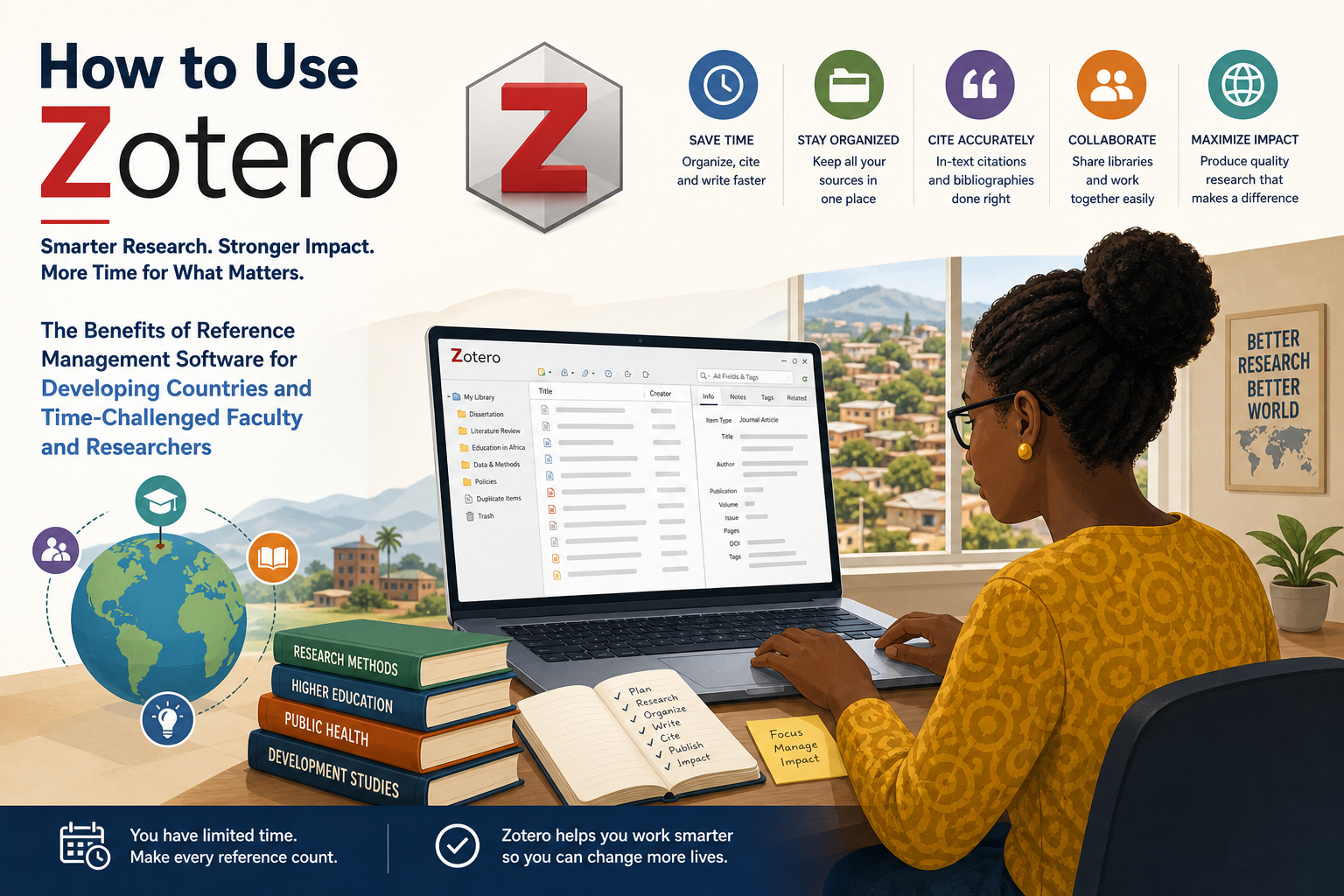
Studies propose that one major way to solve the problem of time in research and writing is to use referencing technology (Katz et al., 2020; Vijai et al., 2019). Reference management software (RMS) is a tool that helps collect references digitally and makes it easy for the researcher to store and categorize sources. RMS may help increase productivity, minimize plagiarism by making citations easy and integrated in the document or the web browser (Vijai et al., 2019, p. 591). RMS does more than just list books; it integrates with the researcher’s workflow to minimize the risk of accidental plagiarism and streamline the technicalities of formatting (Vijai et al., 2019, p. 591). It has been argued that citation software has become very important in disseminating research (Katz et al., 2020, p. 3). RMS and citation software are synonymous and are also referred to as reference manager, a citation manager, bibliographic management software, and literature management software (Vijai et al., 2019, p. 591)
Vijai et al. have identified several major RMS: RefWorks, Mendeley, EndNote, Zotero, Citavi, Paperpile, JabRef, Papers, and Docear (Vijai et al., 2019, pp. 592–593).
While the necessity of RMS is clear, the selection of a specific platform is a strategic decision that depends on a researcher’s institutional support, budget, and technical workflow. Vijai et al. (2019) identify Zotero, Mendeley, and EndNote as the dominant players in the field. Zotero is open-source software. This means that it is free and is easily downloadable by researchers in developing countries. They do not require substantial institutional financing or library budgets. Zotero has an easy-to-input system for DOI. Web browser integration via plugin has also made Zotero a very user-friendly RMS. Automated PDF renaming, as well as easy integration into popular word processors like Google Docs and LibreOffice, can make an open-source-minded researcher feel at ease. This means that research can be done with a lower budget, and university-wide adoption may also come at a lesser or no additional cost. The primary limitation of Zotero is the 300MB free cloud storage. For researchers who need to store large quantities of digital files in the cloud, this may be a challenge. However, this limit may be augmented by the use of external cloud services like Dropbox or Google Drive, which offer substantially more space in the cloud. For those who do their research processing and storing in their personal computers, this limitation is of no consequence. Zotero can work just as well in the absence of cloud storage. However, creating a Zotero account may prove to be wise in case of a failure of the researcher’s personal computer. It helps to have an online backup of hard-earned research. Zotero offers all major formatting styles, including the latest APA 7th edition.
Zotero has to be installed as an application on Windows, macOS, or Linux. Once installed, one may open their word processor and check if Zotero is already added.

The Zotero bar will show the following options: add/edit citations, add/edit bibliography, insert note, and three small buttons for document preferences, refresh, and unlink citations.

Refresh – this button refreshes the citations and keeps the page updated with the paginations keyed in. This will also refresh the Bibliography, should new citations have been made in the body.
Unlink citations – this button will unlink all the citations and will “flatten” the document. Once pressed, the citations will remain as texts in the soft copy, and Zotero will no longer update or change any of the citations in the document. This may be useful in case the paper has been finished and all edits have been done. The document may be unlinked from one’s Zotero app and saved as a PDF for purposes of dissemination.
Document preferences – this button allows one to change the formats and citation styles. As there are many citation styles in the academic world, it is a challenge for authors to memorize every format. But with RMS, the work becomes much easier.

Clicking “Manage Styles” will allow one to search for other available citation formats.

Zotero currently has 10,844 citation styles available in its catalog. This capacity to shift from one style to another has made RMS very important for those who submit to journals with different citation formats. For example, journals may follow disciplinary formats, regional formats, or other kinds. Zotero has a search bar that allows one to search for the format one needs.

Inputting sources in the Zotero app is fairly easy. There are two major ways to input. The first is by locating the “new item” tab and clicking. The new item tab will open a field box, and one would have to input the required details oneself, like the full names of the author, the name of the publication, the volume number, the issue, and others. Though this may seem like such work compared to the manual typing of every citation and every footnote or inline text citation, this will prove to be an easy way to use.

Identify the kind of source that one seeks to add.

Input the details required. It is still useful to consult the proper style or publication guide. For users of the APA 7th edition, the APA handbook is suggested. Consult university research centers for your proper citation information.

We copy the DOI number and paste it in Zotero.

Zotero will add all the details in one’s folders.

Using the stored citation is easy. Proceed with the writing of the citation from the word processor. Locate the Zotero tab.

The app will generate the citation.

By clicking the Add/Edit Bibliography button, one may add a complete bibliography of all references cited.

Zotero is a time-saving tool that would greatly benefit researchers and academic writers. With this particular RMS, the difficulty in managing and keeping track of all bibliographic sources and their paginations will be minimized.
There are other RMS. Mendeley by Elsevier is another RMS. Mendeley has a more generous free online storage of 2GB. However, the acquisition of Mendeley by Elsevier may have a “lock-in” effect for users. EndNote is another option used by heavy researchers in the medical and scientific research environments. EndNote offers the most extensive library of citations. However, unlike Zotero or Mendeley, EndNote is a premium product with a high licensing fee. For a faculty member in a resource-constrained Philippine HEI, this cost can be prohibitive unless the university provides a site license. Additionally, its steep learning curve often requires formal training to master.
To increase research and publications, HEIs must consider RMS policies for the research faculty. RMS may help greatly for researchers, faculty members, and students. If Philippine HEIs want to overcome the “time obstacle,” they must treat RMS training not as an optional skill but as a core faculty competency. By automating the mechanical aspects of citation, faculty can reclaim the cognitive energy needed for the actual “cooking”—the synthesis and creation of new knowledge.
For authors, faculty members, and students who may find the act of writing a challenge, playing with the RMS software may actually help reorganize one’s thoughts and make the act of writing just easier enough to make it pleasurable.
Combine RMS with a diligence of writing, even just 500-1000 words a day in one’s spare time, and a more productive academic life can be had.
Life is finite, and time is constantly linear. Time-consuming activities have to be balanced. Time management is a valuable skill. Technologies that help educators and researchers save time will be critical in sustaining the passing of knowledge and, more importantly, the creation of knowledge for the betterment of society. Researchers may find the value of time-saving applications and software to make a less stressful life and a more productive future.
Aside from the common sense to balance the load of faculty members and to rationalize research resources, HEIs seeking to expand their research capacities should consider technologies that help further education growth and productivity to address research and publication woes.
Copyright notice. Zotero, Microsoft Word, EndNote, and all copyright and trademarks belong to their respective owners. Reviewed for academic purposes only. All images are screenshots by the author. No copyright infringement intended. Zotero and its logo are copyright of Corporation for Digital Scholarship (CDS).
References:
Bonaparte, I., Abbey, A., & Okoro, E. (2015). Challenges facing beginning Faculty in the 21st Century Higher Education: Evaluating Research Productivity, Teaching Effectiveness, And Service. International Journal of Academic Research in Progressive Education and Development, 4(1), Pages 143-162. https://doi.org/10.6007/IJARPED/v4-i1/1622
Katz, D. S., Chue Hong, N. P., Clark, T., Muench, A., Stall, S., Bouquin, D., Cannon, M., Edmunds, S., Faez, T., Feeney, P., Fenner, M., Friedman, M., Grenier, G., Harrison, M., Heber, J., Leary, A., MacCallum, C., Murray, H., Pastrana, E., … Yeston, J. (2020). The importance of software citation. F1000Research, 9, 1257. https://doi.org/10.12688/f1000research.26932.1
Ng, S. H. S., & Lai, J. W. (2025). AI-augmented heutagogy: A framework for fostering self-determined learning and agency in higher education. Higher Education Research & Development, 1–21. https://doi.org/10.1080/07294360.2025.2564977
Salazar-Clemeña, R. M., & Almonte-Acosta, S. A. (2007). Developing research culture in Philippine higher education institutions: Perspectives of university faculty. UNESCO Forum on Higher Education, Research and Knowledge, 1–14.
Vecaldo, R., Asuncion, J. E., & Ulla, M. (2019). From Writing to Presenting and Publishing Research Articles: Experiences of Philippine Education Faculty-Researchers*. Eurasian Journal of Educational Research, 19(81), 1–18. https://doi.org/10.14689/ejer.2019.81.9
Vijai, C., Natarajan, K., & Elayaraja, M. (2019). Citation Tools and Reference Management Software for Academic Writing. SSRN Electronic Journal. https://doi.org/10.2139/ssrn.3514498
Wa-Mbaleka, S. (2015). Factors leading to limited faculty publications in Philippine higher education institutions. International Forum Journal, 18(2), 121–141.


