Likha Journal 2024
-

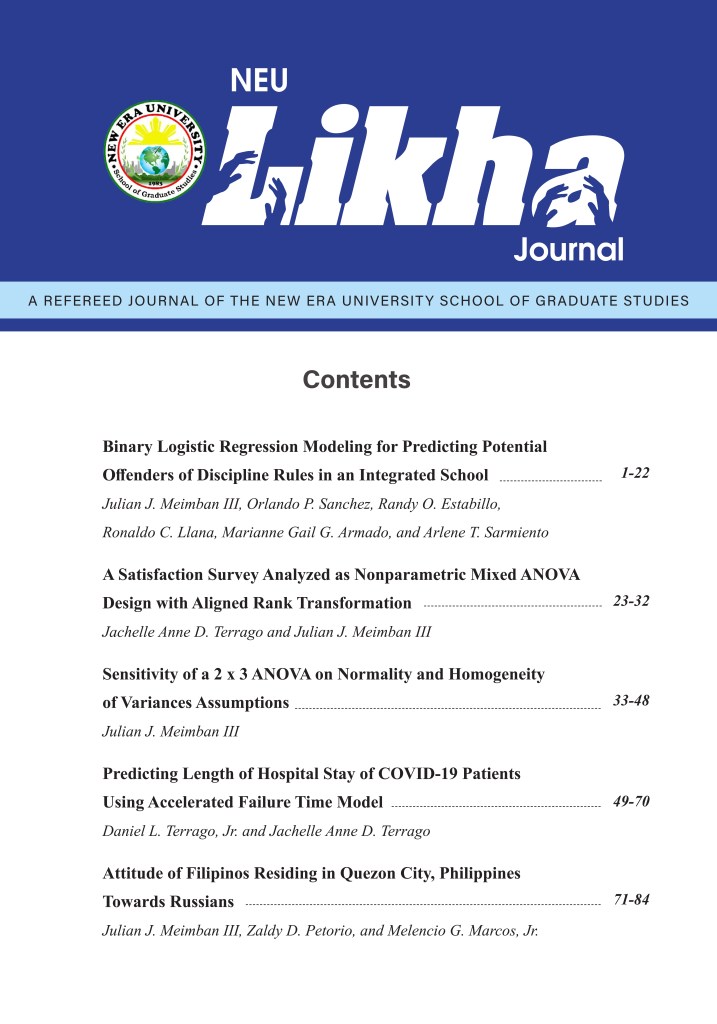
Binary Logistic Regression Modeling for Predicting Potential Offenders of Discipline Rules in an Integrated School
Two binary logistic regression models (Model C and Model D) were selected from four alternative models developed to determine if a combination of gender, religion, and grade level could significantly predict potential violators of school discipline rules. Grades 7 to 12 students enrolled during the Academic Year 2022-2023 in a private Integrated School in Quezon City, Philippines composed the target population of the study. The 753 sample cases used was… Click to Read the Full Article
-

A Satisfaction Survey Analyzed as Nonparametric Mixed ANOVA Design with Aligned Rank Transformation
Satisfaction survey data from a University’s Science Fair was analyzed using nonparametric Mixed ANOVA (with aligned rank transformation). The dependent variable was the satisfaction score and the independent variables (between-subjects factors) were GENDER (male, female) and GROUP (student, exhibitor, and faculty). The variable ITEM (with seven items) was the within-subjects factor. A seven-item, 1-5 Likert scale (1-Very Poor, 2-Poor, 3-Satisfactory, 4-Good, 5-Excellent) questionnaire was administered to 162 respondents, randomly selected… Click to Read the Full Article
-

Predicting Length of Hospital Stay of COVID-19 Patients Using Accelerated Failure Time Model
The objective of the study was to predict the length of hospital stay (LOS) of COVID-19 patients using accelerated failure time model (AFT). Estimates of LOS can be used to project demands and to allocate resources efficiently. Retrospective data of 131 recovered patients who were admitted at a secondary hospital in Quezon City, Philippines was used for model development while another set of 131 patients’ records was used for model… Click to Read the Full Article
-

Attitude of Filipinos Residing in Quezon City, Philippines Towards Russians
Attitude (sense of intimacy/affinity or antipathy) of Filipinos living in Quezon City, Philippines toward Russians was determined using an enhanced 7-item Bogardus’ Social Distance Scale. Based on power analysis for a 2 x 3 x 3 ANOVA design, 209 respondents were required and randomly selected to analyze the main effects and interaction effects of three independent variables (gender, age, and social class) on one dependent variable (a composite attitude score).… Click to Read the Full Article